
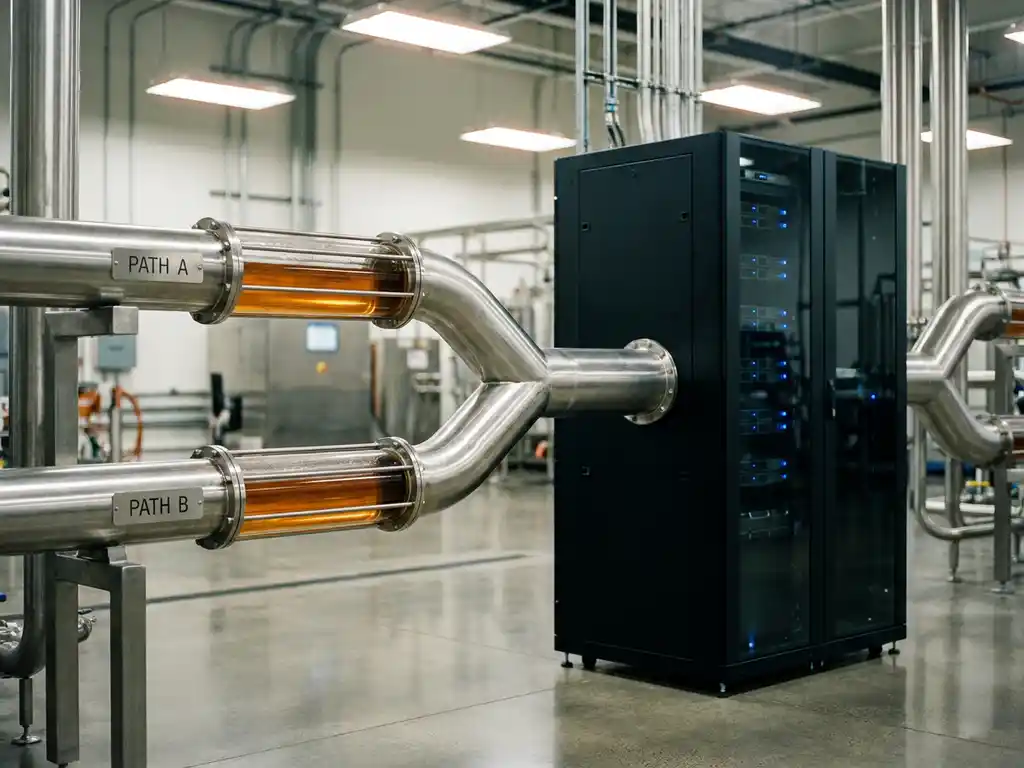
ETL (Extract, Transform, Load) and ELT (Extract, Load, Transform) differ in one fundamental way: where the transformation happens. In ETL, data is cleaned and structured before it enters the destination system. In ELT, raw data lands in the destination first, and transformations run there using the warehouse’s own compute power. The right choice depends on your infrastructure, your data sources, and how much flexibility your team needs downstream.
For data engineering teams working across complex environments – manufacturing, energy, IoT-heavy stacks – this architectural decision shapes everything from pipeline reliability to how quickly analysts can access trusted data. The sections below break down the key questions practitioners actually face when choosing between these two approaches.
When does ETL outperform ELT – and when does it fall short?
ETL outperforms ELT when data must be cleaned, masked, or restructured before it reaches the destination – particularly for regulatory compliance, sensitive data handling, or legacy systems that cannot ingest raw or semi-structured formats. If your destination system has strict schema requirements or limited compute capacity, transforming data upstream makes practical sense.
Traditional ETL pipelines shine in environments where data governance is enforced at the point of ingestion. When a financial record or personally identifiable information must be anonymized before it ever touches a data warehouse, ETL gives you that control. The transformation logic lives in a dedicated processing layer, which keeps the warehouse clean by design.
Where ETL falls short is flexibility. When business requirements change, transformation logic buried in ETL jobs becomes expensive to update. Teams often find themselves maintaining brittle pipelines where a single schema change upstream breaks downstream processes. Debugging is harder because the data has already been altered by the time it reaches the warehouse, making it difficult to trace errors back to their source. For teams dealing with evolving data models or exploratory analytics, this rigidity becomes a genuine bottleneck.
How does ELT take advantage of cloud data warehouses?
ELT takes advantage of cloud data warehouses by offloading transformation work to platforms like Snowflake, BigQuery, or Databricks, which are purpose-built to run large-scale SQL and compute jobs efficiently. Instead of maintaining a separate transformation server, your team writes transformation logic directly in the warehouse using tools like dbt, and the warehouse scales compute on demand.
This approach fundamentally changes the economics of data engineering. Cloud warehouses separate storage from compute, meaning you only pay for the processing power you use during a transformation run. Raw data can be stored cheaply and transformed multiple times with different logic, without re-ingesting anything from the source. This makes iterating on data models significantly faster.
ELT also preserves the full history of raw data. Because nothing is discarded before landing, analysts and engineers can go back to the source of truth and reprocess data with updated business logic. For teams building machine learning pipelines or experimenting with new feature engineering approaches, this is a significant practical advantage over ETL architectures where raw data may never be retained. If you want to understand how this fits into a broader software and data strategy, it is worth looking at how these architectural choices connect to your wider platform decisions.
What are the real performance differences between ETL and ELT?
The real performance difference comes down to where compute is applied. ETL relies on a separate processing layer – often a dedicated server or middleware tool – that can become a bottleneck as data volumes grow. ELT pushes transformation work into the cloud warehouse, which scales horizontally and can process large datasets in parallel without the same infrastructure constraints.
In practice, ELT tends to outperform ETL at scale for batch workloads because modern cloud warehouses are optimized for exactly this kind of columnar, aggregation-heavy processing. A transformation that might take hours on a traditional ETL server can run in minutes on a well-configured warehouse cluster.
ETL can still win on latency for specific use cases. If you need lightweight, near-real-time transformations on streaming data before it hits a destination, a well-tuned ETL layer with tools like Apache Flink or Kafka Streams can deliver lower end-to-end latency than a warehouse-based ELT approach. The honest answer is that raw throughput favors ELT at scale, while low-latency streaming scenarios may still favor purpose-built ETL processing.
How does data quality and observability differ between the two approaches?
In ETL, data quality checks happen during the transformation phase before data reaches the destination, which means bad data can be caught and rejected early. In ELT, raw data lands first and quality checks run as part of the transformation layer inside the warehouse, giving teams more visibility into what raw data actually looks like before and after transformation.
Data quality in ETL pipelines
ETL quality checks are often embedded in the transformation code itself, which makes them tightly coupled to the pipeline logic. This works well when quality rules are stable and well-understood. The downside is that if a quality check fails mid-pipeline, the data may be silently dropped or routed to an error queue that nobody monitors consistently. Observability depends heavily on how well the ETL tool logs failures and whether alerting is configured proactively.
Data quality and observability in ELT pipelines
ELT architectures, particularly those built around dbt, naturally support more visible quality frameworks. Tests are defined alongside models and run as part of the transformation job, producing clear pass/fail results that are easy to track over time. Tools like Elementary or Monte Carlo integrate directly with this layer to provide anomaly detection, freshness checks, and lineage tracking. Because raw data is always available in the warehouse, debugging a quality failure means querying the original records directly rather than trying to reconstruct what the ETL pipeline saw.
For data engineering teams serious about pipeline reliability, ELT’s observability story is generally stronger in 2026 because the tooling ecosystem has matured around warehouse-native architectures. That said, quality without governance is still just noise. Whether you use ETL or ELT, quality rules need to be enforced in code, not documented in a wiki that nobody reads.
Which approach fits OT/IoT and manufacturing data pipelines?
Manufacturing and OT/IoT environments typically call for a hybrid approach: lightweight ETL at the edge to normalize and filter high-frequency sensor data, followed by ELT inside the cloud data platform for broader transformation and analytics. Neither pure ETL nor pure ELT alone handles the full complexity of integrating SCADA systems, MES data, and historian databases with enterprise analytics.
The challenge with OT data is volume and variety. A single production line can generate thousands of sensor readings per second. Sending all of that raw to a cloud warehouse without any edge processing is expensive and often impractical given network constraints in industrial environments. A thin ETL layer at the edge – filtering noise, resampling time-series data, and applying basic normalization – reduces what needs to travel to the cloud while preserving meaningful signal.
Once that data reaches the cloud platform, ELT takes over. Historians, MES exports, and SCADA event logs can be loaded in raw form and transformed using warehouse-native tools alongside data from ERP systems and SaaS applications. This is where OT and IT data finally converge into a unified model that production planners, quality engineers, and data scientists can all query from the same source of truth.
This OT-IT integration work is exactly where we spend a significant part of our data engineering practice. The bridge between the factory floor and the data platform is not a solved problem you can buy off the shelf – it requires engineers who understand both the industrial protocols and the modern data stack. Our managed services are designed to support exactly these kinds of complex, long-running data environments.
Should you choose ETL, ELT, or a hybrid architecture?
For most modern data engineering teams, ELT is the default starting point – especially if you are already running on a cloud data warehouse. It offers more flexibility, better observability tooling, and lower infrastructure overhead than traditional ETL. Choose ETL when regulatory requirements demand pre-destination transformation, when your destination system cannot handle raw data, or when you are working with streaming pipelines that require low-latency processing before storage.
A hybrid architecture is the right answer for organizations with complex data environments – particularly those combining OT and IT data sources, or those with a mix of real-time and batch workloads. In practice, many mature data platforms use streaming ETL for time-sensitive operational data and ELT for everything else, with a shared governance layer that applies quality rules consistently across both paths.
The architecture question is ultimately secondary to the execution question. A well-built ETL pipeline with solid observability will outperform a poorly implemented ELT stack every time. What matters most is whether your pipelines are reliable, your transformations are tested, your data is documented, and your team can debug failures at two in the morning without waking up the CEO.
If you are working through this decision for your own stack and want a team that has built these architectures in manufacturing, energy, and agritech environments, talk to our data engineering team about what a production-ready platform looks like for your specific context.
Frequently Asked Questions
How do I know if my current ETL setup is ready to migrate to ELT?
Start by auditing your existing transformation logic: if most of your transformations are SQL-expressible and your team is already using a cloud data warehouse like Snowflake, BigQuery, or Databricks, migration to ELT is likely straightforward. The bigger signal is whether your current ETL pipelines are causing bottlenecks — slow iteration on data models, brittle schema dependencies, or limited visibility into raw data are all strong indicators that an ELT architecture would serve you better. A phased migration, starting with lower-risk pipelines, is usually the safest path rather than a full cutover.
What are the most common mistakes teams make when implementing ELT for the first time?
The most frequent mistake is treating the warehouse as a dumping ground — loading raw data without any governance, naming conventions, or access controls, and assuming dbt alone will sort out the chaos later. A second common pitfall is skipping data quality tests during the early build phase, which creates technical debt that compounds quickly as more models are added. Establish a clear layer structure (raw, staging, marts), define your testing standards before you write your first model, and instrument freshness checks from day one.
Can ELT handle real-time or near-real-time data requirements?
ELT as traditionally implemented is optimized for batch workloads, so pure real-time processing is not its strongest suit. However, tools like Databricks Structured Streaming and Snowflake’s dynamic tables are closing this gap for near-real-time use cases. For strict low-latency requirements — think sub-second operational decisions or live alerting — a dedicated streaming layer using Apache Flink or Kafka Streams upstream of the warehouse is still the more reliable choice, consistent with the hybrid architecture described in this post.
How should we handle sensitive or regulated data in an ELT architecture where raw data lands first?
This is one of the most important design decisions in an ELT architecture and should not be an afterthought. Sensitive fields should be masked, tokenized, or encrypted at the ingestion layer before raw data is written to warehouse storage — effectively creating a “clean raw” zone rather than a truly unmodified raw zone. Role-based access controls should be applied at the raw layer so that only authorized service accounts and engineers can query unmasked data. Tools like column-level security in Snowflake or BigQuery’s data policies make this enforceable at the platform level rather than relying solely on application logic.
What tooling stack should a team new to ELT start with in 2025?
A practical and widely adopted starting stack is: a cloud data warehouse (Snowflake, BigQuery, or Databricks depending on your cloud provider and use case), an ingestion tool such as Fivetran, Airbyte, or a custom connector for proprietary sources, dbt Core or dbt Cloud for transformation and testing, and Elementary or Monte Carlo for observability. This combination covers ingestion, transformation, testing, and monitoring without requiring you to build infrastructure from scratch. Start simple — one ingestion source, one dbt project, basic tests — and expand from there rather than trying to implement the full stack at once.
In a hybrid ETL/ELT architecture, how do you maintain consistent data quality rules across both paths?
The key is centralizing your quality rule definitions so they are not duplicated and maintained separately in two different systems. In practice, this often means defining canonical business rules in dbt tests that run on the warehouse-side ELT path, and mirroring critical checks in the edge ETL layer for the data that needs early validation. A shared data contract — a documented agreement on expected schemas, value ranges, and freshness SLAs — gives both pipeline paths a common standard to validate against. Platforms like Soda or Great Expectations can help enforce these contracts consistently regardless of where in the pipeline the check runs.
How do we estimate the cost difference between running ETL on dedicated infrastructure versus ELT on a cloud warehouse?
A useful starting point is to compare your current ETL infrastructure costs (servers, licensing, maintenance engineering time) against the projected warehouse compute costs for running equivalent transformations. Cloud warehouses bill on query compute time, so profiling your transformation workloads — how many rows, how frequently they run, how complex the SQL — gives you a reasonable estimate. In most cases, ELT on a well-optimized cloud warehouse is more cost-efficient at scale because you are not paying for idle compute between runs. The hidden cost to account for on the ELT side is query optimization: poorly written dbt models on large datasets can generate unexpectedly high warehouse bills, so query efficiency becomes a first-class engineering concern.
Related Articles
- How do you integrate SCADA systems into a modern data platform?
- How do you build a data platform that teams actually trust?
- How do you reduce the time your team spends moving data around?
- What causes data quality problems across business units?
- Why do different teams always get different numbers from data?