
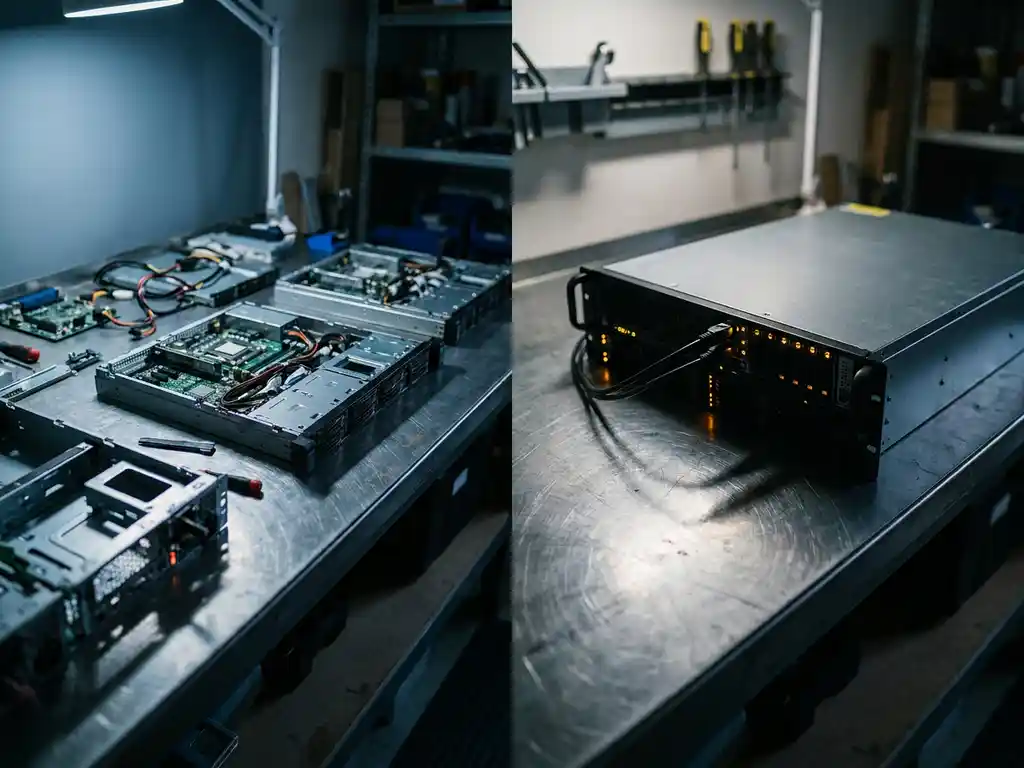
Whether to build or buy your data platform infrastructure depends on your team’s engineering capacity, your budget for ongoing maintenance, and how differentiated your data needs are. For most organizations, the honest answer is neither pure build nor pure buy — it is a deliberate hybrid, where commodity infrastructure is purchased and competitive differentiation is engineered in-house. The questions below break down exactly how to make that call.
What are the real trade-offs between building and buying a data platform?
The core trade-off between building and buying a data platform is control versus speed. Building gives your team full ownership over architecture decisions, data models, and cost optimization — but it demands sustained engineering investment. Buying accelerates time-to-value and reduces operational burden, but introduces vendor lock-in and limits how deeply you can customize the platform for your specific domain.
For data engineering teams working in manufacturing, energy, or agritech, this trade-off is especially sharp. Off-the-shelf platforms are designed around SaaS-style data patterns — clean API calls, structured schemas, predictable volumes. They rarely account for the realities of OT environments: SCADA historians, MES outputs, IoT sensor streams with irregular cadence, and operational data that does not arrive in neat JSON payloads.
The buy side offers genuine advantages in areas like query engines, storage management, and catalog tooling — components that have matured significantly and where building from scratch rarely adds competitive value. The build side matters most when your data sources, access patterns, or governance requirements are genuinely uncommon. The mistake most teams make is treating this as a binary choice rather than a component-by-component decision. If you are evaluating how a data and software strategy fits your organization, starting with that component-level analysis is the right first step.
What does it actually cost to build a data platform from scratch?
Building a data platform from scratch typically costs far more than initial estimates suggest, because the visible costs — cloud infrastructure, tooling licenses, engineering salaries — are only part of the picture. The hidden costs are the ones that compound: pipeline maintenance, schema drift, incident response, documentation debt, and the opportunity cost of senior engineers debugging broken ingestion jobs instead of delivering analytical value.
A realistic build effort for a mid-sized organization includes months of foundational work before a single analyst gets reliable data. You need to design and implement ingestion layers, transformation logic, data quality frameworks, orchestration, observability, and access control — each of which is a non-trivial engineering problem in its own right. Then you need to keep it running.
Maintenance is where build costs consistently surprise teams. Pipelines break when upstream systems change. Schemas evolve without notice. New data sources require new connectors. In practice, many data engineering teams find themselves spending the majority of their time on pipeline reliability rather than on the analytical work that justifies the platform’s existence. That imbalance is not a failure of execution — it is a predictable consequence of underestimating total cost of ownership when building from scratch.
Which data platform components should never be built in-house?
Certain data platform components should almost never be built in-house, because they are engineering-intensive, well-solved by existing products, and provide no competitive differentiation. These include query engines, columnar storage formats, metadata catalogs, and orchestration schedulers. Building your own version of Spark, Iceberg, or Airflow is not a strategic investment — it is a distraction from the work that actually creates business value.
The same logic applies to most transformation frameworks. Tools like dbt have become the standard for a reason: they provide lineage, testing, documentation, and version control out of the box. Replicating that functionality in custom SQL scripts or bespoke Python pipelines creates fragile systems that only the original author can maintain.
Connector libraries are another area where buying wins clearly. Modern ingestion platforms handle hundreds of source integrations, authentication schemes, and API pagination patterns that would take months to replicate. Unless your source system is genuinely obscure — a legacy SCADA protocol or a proprietary historian format — buying a connector is almost always the right call. The engineering effort is better spent on the logic that sits downstream of ingestion, where your domain knowledge actually creates an advantage.
When does building your own data platform actually make sense?
Building your own data platform components makes sense when your data patterns are genuinely unusual, when regulatory requirements prevent you from using managed cloud services, or when the volume and complexity of your data make off-the-shelf solutions prohibitively expensive at scale. These are real scenarios — but they apply to a smaller proportion of organizations than most teams assume when they start scoping a build project.
In industrial sectors, there is one area where custom engineering consistently pays off: OT-IT integration. The bridge between factory-floor systems — SCADA, MES, historian databases, IoT gateways — and a modern data platform is not a problem that commercial tools solve well out of the box. The protocols are specialized, the data models are non-standard, and the latency and reliability requirements differ from typical SaaS integrations. Teams that build robust, well-monitored ingestion pipelines for operational data create a genuine competitive asset.
Custom transformation logic is another area where building adds value — specifically, the business rules and domain models that encode how your organization actually interprets its data. A generic platform cannot know that a particular sensor reading is only valid within a specific pressure range, or that a production order status needs to be reconciled against three upstream systems before it can be trusted. That logic belongs to your team, and it should be built, tested, and version-controlled accordingly.
How do hybrid data platform strategies work in practice?
A hybrid data platform strategy means deliberately choosing which components to buy as managed services and which to build as custom engineering — based on where your team’s effort creates the most value. In practice, this looks like running a managed lakehouse on a cloud provider, using a commercial orchestration tool for scheduling, and building custom ingestion pipelines and transformation logic that reflect your specific domain.
The buy layer: commodity infrastructure
The buy layer handles everything that is well-solved and undifferentiated: cloud storage, compute, query optimization, catalog tooling, and monitoring dashboards. Managed services from AWS, Azure, or GCP handle the operational burden of keeping these components available, patched, and scaled. Your team does not need to own that work — and paying for it is almost always cheaper than staffing it internally. Managed services delivered by a specialist partner can take this further, covering not just infrastructure but the ongoing operational responsibility that comes with it.
The build layer: domain-specific engineering
The build layer is where your data engineering team focuses its effort: the connectors that pull from your specific OT systems, the quality rules that reflect your business definitions, the data models that encode your operational logic, and the observability that tells you when something has gone wrong before the business notices. This is where hands-on expertise in your sector translates directly into platform reliability.
The discipline in a hybrid strategy is resisting the urge to build what you can buy, and resisting the urge to buy what genuinely needs to be built. Teams that get this balance right end up with platforms that are both operationally stable and strategically differentiated.
What questions should you answer before making the build-or-buy decision?
Before committing to a build-or-buy decision for your data platform, your team should be able to answer six questions clearly. These questions force the trade-offs into the open and prevent the most common failure mode: choosing based on preference rather than evidence.
- What is our actual engineering capacity? Not headcount, but available hours after existing maintenance and delivery commitments. Building requires sustained investment, not just a sprint.
- How unusual are our data sources? Standard SaaS connectors and API integrations favor buying. Proprietary industrial protocols, historian systems, and SCADA integrations favor custom engineering.
- What are our regulatory constraints? Data residency requirements, sector-specific compliance obligations, and frameworks like NIS2 may restrict which managed services you can use.
- What is our expected data volume and growth trajectory? Some managed services become expensive at scale; some custom builds become unmaintainable at scale. Both need to be modeled honestly.
- Where does our competitive advantage actually live? If your edge is in operational efficiency, your data platform should reflect that — which means investing engineering effort in the pipelines that surface operational data reliably, not in rebuilding commodity infrastructure.
- Who will own this long-term? A platform is only as good as the team maintaining it. If the engineers who built it leave, a heavily custom platform becomes a liability. Bought components with strong community support and documentation are easier to hand over.
Answering these questions honestly often reveals that the real decision is not build versus buy — it is which components to build and which to buy. If you want a partner who works through these trade-offs with you and then actually helps implement the result, get in touch with our team to talk through your specific situation.
Frequently Asked Questions
How do we know when we've outgrown a bought platform and need to start building custom components?
The clearest signal is when your team consistently hits the edges of what the platform supports — workarounds become the norm, vendor roadmaps no longer align with your needs, or licensing costs at your data volume no longer justify the value delivered. At that point, it’s worth doing a component-by-component audit: identify which parts of the platform are genuinely constraining you, and scope a targeted build effort for those specific layers rather than replacing everything at once.
What's the biggest mistake teams make when implementing a hybrid data platform strategy?
The most common mistake is letting the boundary between the build and buy layers drift over time — usually by gradually building custom wrappers around bought components until the team is effectively maintaining both. This happens when bought tools don’t quite fit and engineers patch around them instead of escalating the mismatch as a strategic decision. Preventing it requires treating the build/buy boundary as an explicit architectural decision that gets revisited regularly, not something set once during initial scoping.
How should we handle vendor lock-in risk when buying managed data platform components?
The most practical mitigation is to keep your data in open formats — Parquet, Delta, Iceberg — stored in cloud object storage you control, so that switching compute or query layers doesn’t require migrating the data itself. Beyond storage, assess lock-in risk at the transformation and orchestration layer: tools like dbt and Airflow have strong open-source foundations that reduce dependency on any single vendor. Full lock-in elimination isn’t realistic, but designing for portability at the data layer gives you meaningful leverage in vendor negotiations and exit scenarios.
How do we make the case internally for investing in custom OT-IT integration pipelines when leadership sees it as infrastructure, not strategy?
Frame it in terms of the decisions those pipelines enable, not the engineering effort they require. If reliable operational data from your SCADA or MES systems is what allows production teams to act on real-time efficiency data, the pipeline is the prerequisite for that business outcome — not a background IT cost. Quantifying the current cost of unreliable or delayed operational data (in analyst hours spent cleaning data, or decisions made on stale information) usually makes the investment case more concrete than technical arguments alone.
What team structure works best for maintaining a hybrid data platform long-term?
Hybrid platforms work best when there’s a clear ownership model: a small platform engineering function responsible for the bought infrastructure layer (configuration, cost management, upgrades) and domain-embedded data engineers who own the custom build layer closest to the business. Without that separation, the commodity maintenance work tends to crowd out the domain-specific engineering, and the build layer degrades. Even in smaller teams, making that distinction explicit — even informally — prevents the most common maintenance failure modes.
How do we evaluate whether a commercial data platform vendor actually supports our industrial data sources before committing?
Ask for a proof-of-concept against your actual data sources, not a demo against synthetic or SaaS-style data. Specifically, test ingestion from your real historian, SCADA output, or MES export — with realistic data volumes, schema irregularities, and connectivity constraints. Most vendors will agree to a scoped pilot; those that resist are usually signaling that the integration is less mature than their documentation suggests. Reference checks with customers in your specific sector are equally valuable and often more revealing than vendor-led demos.
At what point should a growing organization revisit its original build-or-buy decisions?
A formal review makes sense at two natural inflection points: when your data volume or team size doubles, and when your business requirements shift significantly (entering a new market, acquiring a company, or facing new regulatory obligations). Outside of those triggers, a lightweight annual review of platform costs, maintenance burden, and unmet requirements is enough to catch decisions that have aged poorly. The goal isn’t to relitigate every choice constantly — it’s to prevent outdated decisions from quietly becoming technical debt.